Before I knew Pune as a city I would return to as an author, I knew it through student friendships, late-night parathas and an extraordinary response to a distant tragedy.
Key takeaways
- My connection with Pune began during my postgraduate years at SIBM, from 1999 to 2001.
- A rented flat called Bhai Niwas, a motorcycle called Bhai Bike and familiar food joints became part of the geography of friendship.
- Café Bourgeoise and Jaws have since closed, but the memories of time spent there remain.
- The response of students and a local shopkeeper to the 2001 Bhuj earthquake left a lasting impression on me.
- Returning for Pune Book Festival 2026 offers the prospect of discovering new stories in a city that already holds some of my own.
How do you remember a city? Through its landmarks? Through the love of its residents? Through the beautiful memories you make there with people you call friends? Through some extraordinary events that you are a part of? I made my memories of Pune through all of these and through the names we gave things.
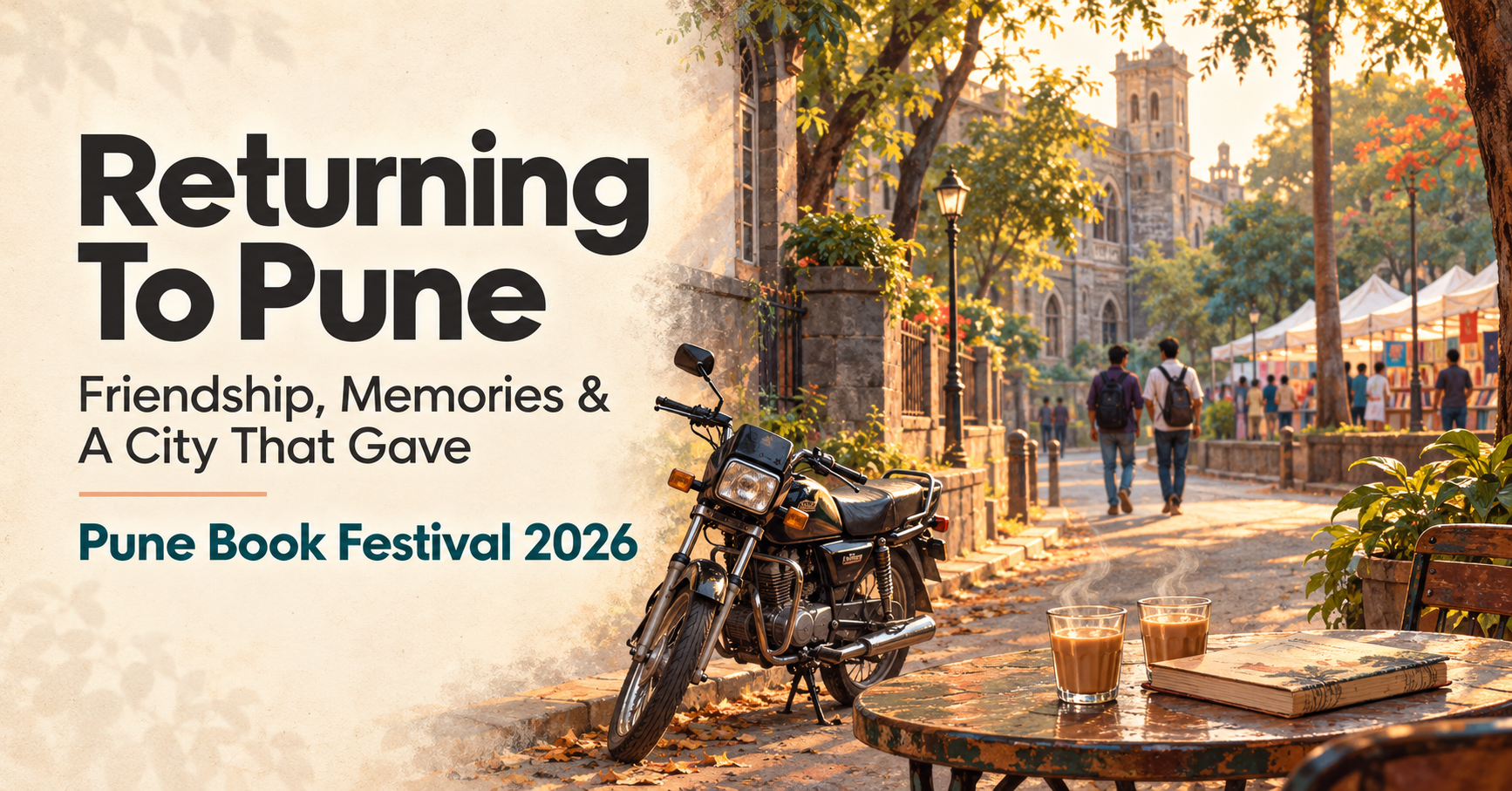
For me, Pune has a Bhai Niwas and a Bhai Bike.
I suspect, neither would have found their way to Google maps. But among friends, the references were perfectly clear then, and now.
As I look forward to visiting Pune Book Festival 2026, I find myself remembering the city where I spent two important years of my life. Before there were novels with my name on their covers, there were classes, friends, shared accommodation and meals that gave us reasons to keep talking.
I studied at SIBM Pune from 1999 to 2001, when the institute was on Senapati Bapat Road. Most of us rented accommodation in nearby areas. Some of us rented a flat in Deep Bangla Chowk.
We called it Bhai Niwas.
A Home with a Name Of its Own
Bhai Niwas gradually became much more than an address. It was where we shared space, routines and the small adjustments required to live with people who have their own ideas about how things should be done.
Soon, along the way, it became our place. Giving it a name probably helped. There were so many accommodations resided in by our classmates. Bhai Niwas had a ring. More importantly, friends knew what ‘Bhai Niwas’ meant when we would say: ‘Let us meet at Bhai Niwas.’
Bhai Niwas belonged to that period when friendship was woven into everyday life. You did not need to plan a reunion or compare calendars several weeks ahead. Friends were, well, around.
One of our friends owned a Hero Honda Splendor, which we rode often enough for it to acquire a place in our shared vocabulary.
Bhai Bike.
We were clearly more consistent with our naming than we were imaginative. These are small memories, but they carry the texture of those years. The place we stayed. The bike we borrowed. The people whose presence we could take for granted because we saw them so often.
Only later do you realise how fortunate that arrangement was.
Pune, One Meal at a Time
Food gives memory a remarkably reliable address.
There was Café Bourgeoise on Bhandarkar Road, where we went late for parathas and tea or coffee. It stayed open well past midnight, a useful quality for a place serving students who were not yet ready to call it a day. I still remember the bourgeoise cacophony of bourgeoise students studying similar subjects at different colleges. Doesn’t matter if some students came from well-to-do or very well-to-do families. Students in themselves are bourgeoise. There’s something romantic about being bourgeoise, and having bourgeoise fun.
There was also a paratha tapri on FC Road. I still remember how good the aunty’s parathas were. My attempt to offer a comprehensive assessment of Pune’s food scene from those years would be very incompetent. I can, however, confirm that parathas occupied an important position in mine.
Then there was Jaws and its oversized, delicious burgers. Many an evening was spent there with friends.
Looking back, I consider that time well invested. A conversation does not need to produce a conclusion, a plan or an opportunity to have been worthwhile. Sometimes it is enough that you enjoyed being together.
And, of course, there was Kayani Bakery in Pune Camp and its Shrewsbury biscuits.
Bourgeoise and Jaws closed in the 2000s. They belong to an earlier Pune now. But in memory, they remain places I can enter quite easily. I remember them through the people I was with and the pleasure of having somewhere to go together.
The Memory That Changes the Mood
Among these recollections is one that carries a very different weight.
On 26 January 2001, the earthquake struck Bhuj.
I remember seeing the photographs in the newspaper the following day. The devastation was difficult to comprehend. Buildings had collapsed, homes had disappeared and lives had been overturned. It looked like the city had been nuked. We were shattered by the images.
I was in the senior batch at SIBM then. A few of us got together to organise help for the victims. Students from the junior batch joined in too. We asked students to contribute whatever they could in cash and kind. What happened next remains one of my proudest memories of those years.
New clothes, notes, and notes for strangers
I remember that a lot of students gave away new clothes. Even the used ones were in tip-top condition, not the ones you wanted to discard anyway. Some slipped currency notes into the clothes, along with handwritten notes for their ‘brothers and sisters’ in Bhuj.
That gesture has stayed with me for twenty-five years.
The recipients were people we had never met. Yet the messages addressed them as family. Across the distance between Pune and Bhuj, students were trying to send something personal along with the practical help. We wanted our fellow citizens at Bhuj, who had lost so much, to find a parcel prepared with their dignity in mind.
At the time, we were busy collecting and organising. Looking back, I can better appreciate the thought contained in those contributions.
A shopkeeper joins the effort
I no longer remember the amount of cash we collected. But I do remember what we were told it could provide.
A new store had opened in the vicinity. According to the owner, the money was enough to source ration for seventeen families of four for a month. When the owner learned that the supplies were for people affected by the earthquake in Bhuj, he gave us everything at cost. He became part of the effort.
The students had contributed what they could. The shopkeeper used his position to make those contributions go further.
Nobody needed to know the families who would eventually receive the supplies. Knowing that they needed help was enough.
Handing the supplies to the Army
I told you about the rations. Let me tell you about the quantity of clothes. We had two six-foot sacks filled up to the brim with clothes.
After two days of collections, we handed over all the supplies to the Indian Army.
For us, it is an institution we trust completely with the responsibility of getting the help to those who needed it. It was a deeply emotional moment.
There was sorrow for people facing an unimaginable loss. There was pain at what we had seen. There was pride in the way students had responded, and a sense that we had done something, however modest, towards a purpose larger than ourselves.
Those feelings existed together.
The memory still moves me because it includes so many acts of care – students buying clothes, writing notes and contributing money; juniors and seniors working together; a shopkeeper supplying provisions at cost.
I love that Punekar spirit. I love that Indian spirit. When life deals a terrible blow, our people find ways to help one another stand again.
Returning With More Stories Behind Me
When I think of returning to Pune now, all these memories travel together.
The light ones have their place – Bhai Niwas, Bhai Bike, burgers and late-night parathas. So does the memory of students preparing help for families they would never meet.
I write about relationships, technology and moral dilemmas. I am interested in how trust is built, exploited and broken. But my curiosity about human nature also includes the moments when people respond with generosity.
The Bhuj relief effort is one of those memories.
I would not claim that a particular incident explains why I became a writer. Life rarely offers such tidy connections. I do know that the people and experiences of those years remain part of how I look at the world.
What I Hope to Find at Pune Book Festival 2026
At the festival, I hope to discover books, meet people and have the kinds of conversations that become possible when readers gather. Returning to Pune also means allowing the present city to have its say.
My memories are specific to a time. The city has continued living and changing since then. I would like to revisit some familiar places while remaining open to what I do not yet know.
That seems an appropriate way to approach a book festival too. There are books you want to read for sure. And then there is the delightful discovery of books you weren’t aware of when you stepped in.
I went to Pune as a student in 1999. I hope to return this December as an author and a reader. Somewhere in between those identities, there is still a young man who knows exactly what Bhai Niwas means.
FAQs
What is Nitish Bhushan’s connection with Pune?
I studied at SIBM Pune from 1999 to 2001. During those years, some friends and I rented a flat in Deep Bangla Chowk. My memories of Pune include student friendships, familiar food joints and helping organise contributions for people affected by the Bhuj earthquake.
Where was SIBM during his student years?
During my time at SIBM, from 1999 to 2001, the institute was on Senapati Bapat Road.
What were Bhai Niwas and Bhai Bike?
Bhai Niwas was our name for the flat some of us rented in Deep Bangla Chowk. Bhai Bike was a friend’s Hero Honda Splendor that we often rode.
Which Pune cafés and food joints does he remember?
My memories include Café Bourgeoise on Bhandarkar Road, Jaws, a paratha tapri on FC Road and Kayani Bakery in Pune Camp. Bourgeoise and Jaws closed in the 2000s; the references here describe my student years.
How did SIBM students help after the 2001 Bhuj earthquake?
Students from the senior and junior batches contributed money and supplies. I remember students buying new clothes, sometimes adding money and handwritten messages. A local shopkeeper supplied ration at cost, and we handed the collected material to the Indian Army.
Will Nitish Bhushan attend Pune Book Festival 2026?
I am planning to attend. Any confirmed dates or arrangements for meeting readers will be shared separately.
Which of Nitish Bhushan’s Books be available at the Pune Book Festival 2026?
Both the books from his LSBVerse will be available: Love Swipe Blackmail (theme: Temptation, digital trust, secrecy, loyalty and friendship) and its sequel, Shadow Play: Love And Blackmail (Insider vulnerability, reputation, revenge, cyber deception and partnership).
When will the Pune Book Festival 2026 be held and where?
Pune Book Festival 2026 will be held from 12 to 20 December at Fergusson College Ground, Pune.