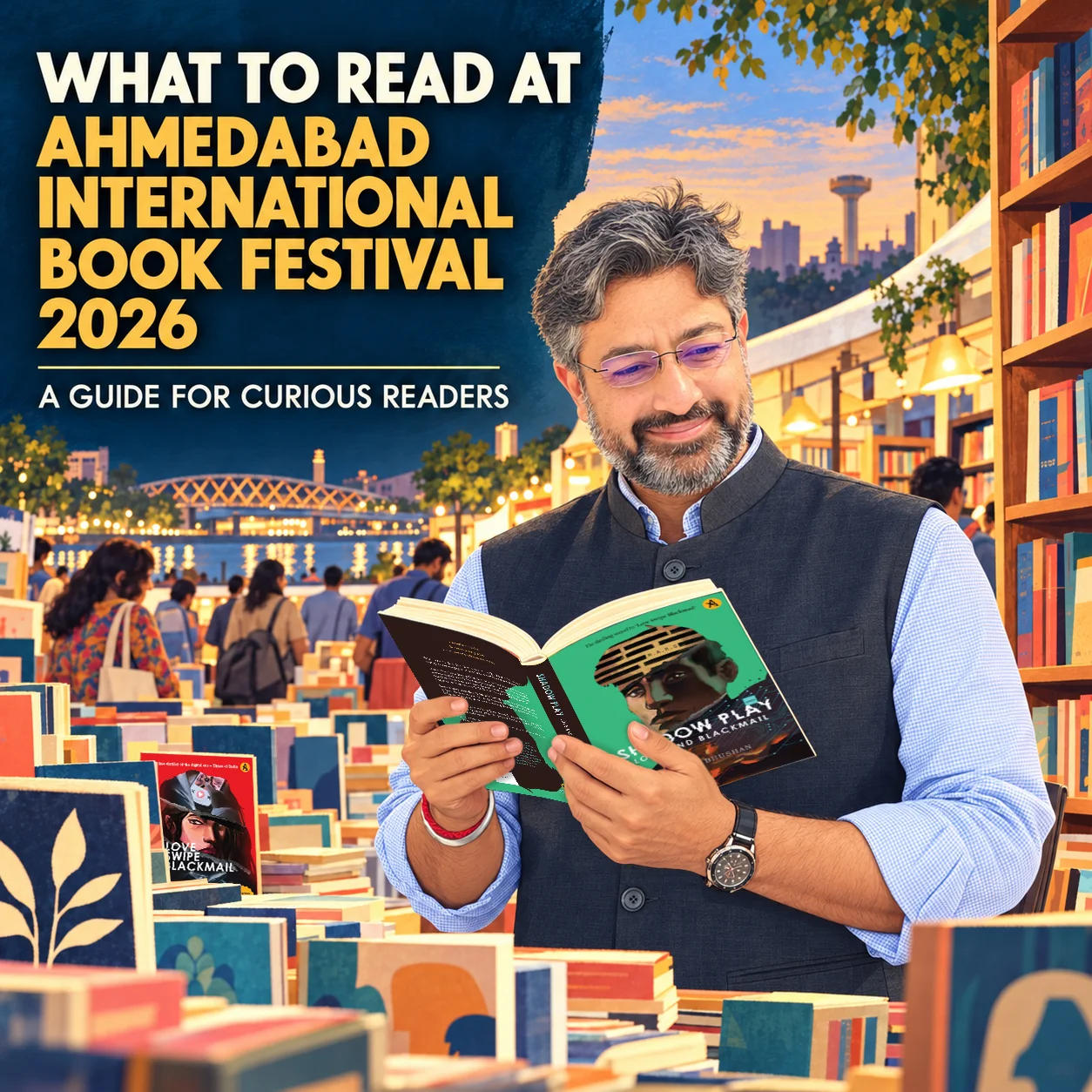
Most of us enter a book festival with one of two plans. We either carry a list of books we already know we want; or arrive with no plan at all and hope that an interesting cover will find us.
Both approaches work. But the real pleasure of the Ahmedabad International Book Festival 2026 may lie somewhere between them: finding the books you wanted while remaining open to those you did not know existed.
The festival will be held at the Sabarmati Riverfront, Ahmedabad, from 24 October to 1 November 2026. With books, publishers and activities competing for attention, the question is not merely, “Which books should I buy?” A more useful question is: What kind of reading experience am I looking for next?
This guide may help you find the answer.
Begin with a reading mood, not a shopping list
You do not need to know the name of a book before entering the festival. You only need to know what you want a book to do for you.
Are you looking for:
- A fast-moving story that keeps you turning pages?
- A book that helps you understand history or current affairs?
- A thoughtful read about relationships and human behaviour?
- Something light after several demanding books?
- A story rooted in a place or culture unfamiliar to you?
- A book that a child in your family might willingly read without persuasion?
- A subject you have always wanted to explore but never begun?
Once you identify the experience you want, conversations at publisher stalls become easier. Instead of asking, “What is your best book?”, you can ask, “Which book would you recommend to someone interested in military history, psychological thrillers or contemporary relationships?”
The second question is far more likely to produce a meaningful recommendation.
Look beyond the books you can find anywhere
There is nothing wrong with buying a bestseller at a festival. Familiar books can be excellent books.
But a festival offers something an online search may not: the possibility of encountering books that have not already been placed in front of you by sales rankings, advertising campaigns or recommendation algorithms.
Visit stalls belonging to independent and smaller publishers. Ask them about:
- A book that deserves more attention
- A recent title that surprised its early readers
- A first-time author with an unusual premise
- A book they find easy to recommend but difficult to categorise
- A title connected to Ahmedabad or Gujarat
- A work translated from another Indian language
The person at the stall may know the publisher’s catalogue better than any search filter. A short conversation could introduce you to a book you would never have discovered by typing a familiar author’s name into a search bar.
Make room for Gujarati writing and Indian-language translations
A book festival in Ahmedabad presents a natural opportunity to explore Gujarati writing; whether in the original language or through translation.
Readers sometimes treat translated literature as a separate, demanding category. It need not be. A translation may simply be a doorway into a different social world, historical memory or style of storytelling.
If you ordinarily read in English, look for translations from Gujarati, Hindi and other Indian languages. If you read Gujarati comfortably, explore contemporary writing as well as established classics. Ask which authors are being read now, not only which ones are already considered canonical.
You may also reverse the process. If you encounter an English or Hindi book you enjoy, find out whether it is available in Gujarati for another reader in your family.
A multilingual festival visit allows people with different reading preferences to discover books together.
Explore familiar interests through unfamiliar genres
Readers often remain loyal to a genre because it reliably gives them what they enjoy. A thriller promises momentum. History promises perspective. Biography offers access to another life. Romance explores emotional choices.
But the boundaries are more porous than bookstore shelves suggest.
A historical novel may lead you towards nonfiction about the same period. A business book may raise questions that a novel explores more intimately. A work of science fiction may reveal more about political power than a conventional political book. A thriller may be less about crime than about trust, shame, ambition or revenge.
Instead of abandoning your favourite genre, approach it from a neighbouring direction.
If you enjoy history, try historical fiction. If you read technology and business, look for fiction about the consequences of technology. If you prefer relationship stories, consider a suspense novel in which relationships create the central vulnerability.
That small sideways step can expand your reading without taking you too far from what you already enjoy.
If you enjoy thrillers, look beyond the crime
A thriller does not become interesting merely because a crime occurs. What matters is the pressure the crime creates, and what people reveal about themselves while responding to it.
While browsing thrillers, consider what kind of tension interests you:
- A mystery built around discovering who committed the crime
- A psychological struggle between characters
- A race against time
- A conspiracy involving businesses or institutions
- A story about digital deception
- A conflict in which reputation matters as much as physical safety
- A moral dilemma in which every available choice carries a cost
The best clue may not be the word “thriller” on the cover. Read the description and ask what is really at stake. Is the character trying to protect a life, a relationship, a career, a secret, an organisation; or an entire country?
Discover fiction about technology, trust and human vulnerability
Technology-driven fiction is sometimes mistaken for fiction meant only for technically inclined readers. But technology is rarely the true subject of a compelling story.
The deeper subject is usually human behaviour.
A dating app matters because it changes how strangers meet, how temptation enters a relationship and how private choices leave digital traces. A cybersecurity breach matters because it can expose secrets, destroy credibility and make colleagues doubt one another. Artificial intelligence matters because it can influence decisions, institutions and the balance of power between countries.
My first novel, Love Swipe Blackmail, begins in the intimate world of relationships. A dating app, a private temptation and a concealed decision turn trust into vulnerability. The technology enables the situation, but the conflict grows out of desire, secrecy, fear and friendship.
The second novel, Shadow Play: Love & Blackmail, expands that world into corporate and institutional conflict. Eerily similar cyber breaches cost two people their careers. What initially appears to be professional negligence begins to resemble a deliberate campaign involving digital deception, social engineering, reputational harm and unresolved grievances.
The progression is from the intimate to the institutional: from what technology can do to trust between people to what the manipulation of trust can do to businesses and public institutions.
These books are relevant examples of a wider kind of contemporary fiction; stories that ask not only what technology can do, but what people may choose to do with it.
Details about their availability at the Ahmedabad International Book Festival will be added once confirmed.
Read the first page before deciding
A book’s cover earns attention. Its description explains the premise. But its first page tells you whether you want to remain in the author’s company.
Before buying an unfamiliar book, read a page or two. Notice:
- Does the voice hold your attention?
- Do you want to know what happens next?
- Is the language accessible or deliberately demanding?
- Does the setting feel alive?
- Are you curious about the character?
- Does the book suit your present reading mood?
You do not have to judge whether the book is objectively good. You only have to decide whether it is right for you at this moment.
Sometimes an excellent book is still the wrong next book.
Let children choose at least one book themselves
Adults frequently choose children’s books according to usefulness: vocabulary, values, knowledge or school performance. Children may choose according to a colourful animal on the cover.
Both criteria can coexist.
If you are visiting with children, allow them to browse and select at least one book for themselves within an agreed budget. A child who participates in choosing a book may feel a greater sense of ownership over reading it.
You can also ask what attracts them to a particular book. Their answer may reveal whether they are drawn to humour, adventure, illustrations, facts, puzzles or a character who resembles them.
The purpose of the visit should not be to make reading feel like additional homework.
Do not measure the visit by the number of books purchased
It is easy to return from a book festival with more books than you can reasonably read. Discounts make the decision even easier, and the unread pile taller.
Before buying a book, ask:
- Will I begin this within the next few weeks?
- Do I already own something similar?
- Am I interested in the book or only attracted by the discount?
- Could another person in my family also enjoy it?
- If I do not buy it today, should I note the title for later?
You can leave a book festival with three carefully chosen books and have a more rewarding visit than someone who leaves with thirty.
The quality of discovery matters more than the weight of the shopping bag.
Create a festival reading trail
A useful way to navigate the Ahmedabad International Book Festival is to divide your attention into four parts:
- One book you already intended to buy
- One book recommended by a publisher or bookseller
- One book from a language, genre or subject outside your usual reading
- One book chosen purely because its opening pages intrigued you
This is not a compulsory shopping list. It is a way of balancing intention with discovery.
You may ultimately buy fewer, or none at all. But the method prevents the festival from becoming either a rigid acquisition exercise or an exhausting wander through endless shelves.
For confirmed dates, venue information and practical planning advice, read the Ahmedabad International Book Festival 2026 visitor guide.
Frequently asked questions
What kinds of books can I look for at Ahmedabad International Book Festival 2026?
Visitors can explore fiction, nonfiction, children’s books, Indian-language writing, translations and books from participating publishers. The exact publisher and stall list should be checked once the organisers release it.
How can I discover books by unfamiliar authors?
Visit smaller and independent publisher stalls, explain your interests and ask for one recommendation. Reading the description and opening page can help you decide whether the book suits you.
Should I prepare a list before visiting the festival?
A short list is useful, but leave part of your time and budget open for unexpected discoveries. Combining planning with curiosity usually creates a better festival experience.
Are technology thrillers suitable for readers without a technical background?
Yes. In accessible technology-driven fiction, technology creates the situation, while people, relationships and choices drive the story. Technical knowledge should not be necessary to understand the conflict.
Are Love Swipe Blackmail and Shadow Play: Love & Blackmail connected?
Yes. They belong to the same fictional world and share characters, but they explore different scales of conflict. Love Swipe Blackmail focuses on dating-app deception and intimate trust, while Shadow Play moves into cyber breaches, corporate rivalry, reputational harm and institutional stakes.
Which Nitish Bhushan novel should I read first?
Begin with Love Swipe Blackmail if you want to experience the story and characters from the beginning. Readers primarily interested in corporate cyber intrigue and reputational warfare may be drawn to Shadow Play, though reading the books in sequence provides the fuller journey.
Will the two novels be available at Ahmedabad International Book Festival 2026?
Their festival availability and stall details will be added once confirmed.
A good book festival does more than help us buy books. It reminds us how many stories, subjects and ways of seeing the world remain undiscovered. Arrive with a plan, but leave enough room for a book to surprise you.