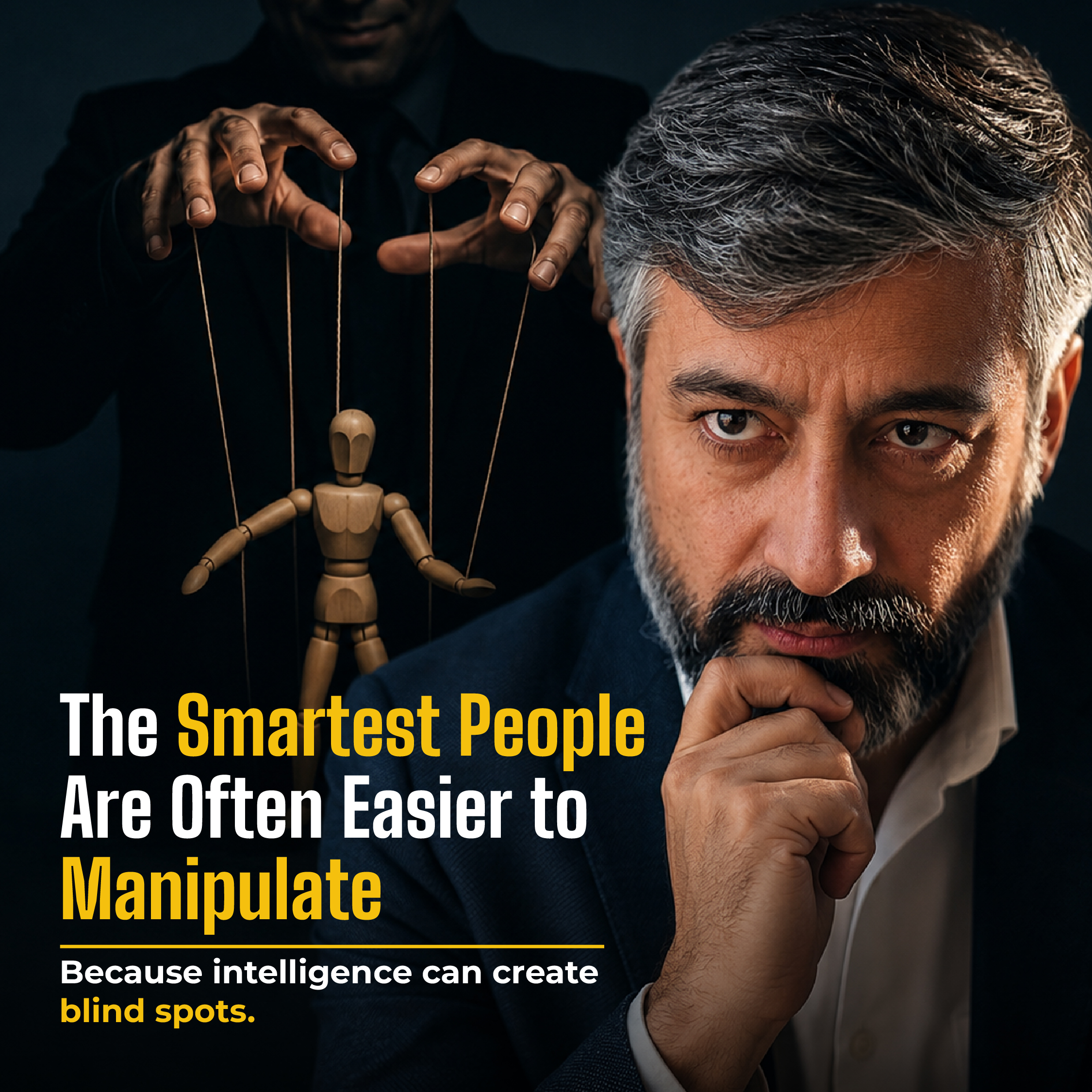
Theme: Intelligence vs emotional vulnerability
Core idea: Manipulators rarely target the least intelligent person in the room. They target the person who believes they can spot manipulation.
The smartest people are often easier to manipulate.
That sounds counterintuitive.
We tend to imagine manipulation working on people who are uninformed, inexperienced, or naïve.
But in many situations, the opposite is true.
Manipulators rarely target the least intelligent person in the room.
They target the person who believes they can spot manipulation.
Because intelligence often creates confidence.
And confidence can quietly become a blind spot.
A senior executive may think:
“I’ve negotiated contracts worth crores. Nobody is fooling me.”
A cybersecurity professional may think:
“I know how phishing works. I can spot a scam from a mile away.”
Someone navigating relationships may think:
“I understand people. I know when someone is being genuine.”
The problem is that manipulation is rarely presented as manipulation.
If it were, nobody would fall for it.
Instead, it arrives disguised as something we already want to believe.
A business opportunity.
A flattering introduction.
An emotionally vulnerable conversation.
A shared interest.
A chance encounter.
A familiar story.
A trusted recommendation.
Manipulation succeeds not because it defeats our intelligence.
It succeeds because it bypasses it.
The most effective manipulators understand that human beings do not make decisions using logic alone. We use trust, emotion, pattern recognition, hope, loneliness, ambition, and occasionally, ego.
And the more certain we are that we can see through people, the less likely we are to examine our own assumptions.
That is why some of the most successful professionals, the most experienced leaders, and the most technically capable experts sometimes make surprisingly human mistakes.
Not because they are foolish.
Because they are human.
Intelligence can help us analyse information.
It does not automatically protect us from believing what we want to be true.
Perhaps the question isn’t:
“Could someone manipulate me?”
The better question is:
“What assumptions am I making that I haven’t bothered to verify?”
That’s usually where the real vulnerability begins.