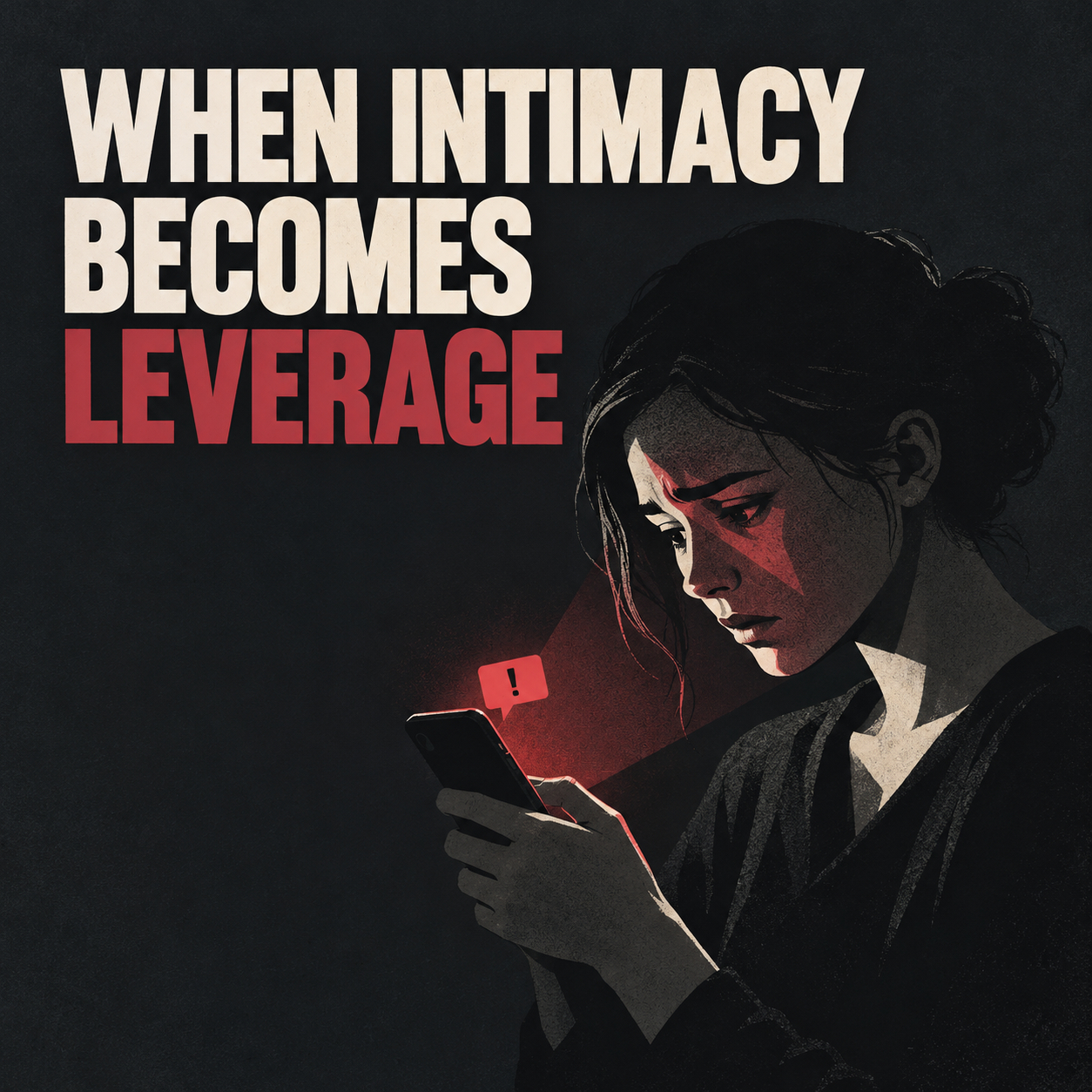
How affection becomes a route to manipulation, why blackmail is not always about money, and what can help someone break free.
Key takeaways
- Dating app scams exploit the trust built through apparent romantic interest. The deception may continue over WhatsApp, social media, calls or in-person meetings.
- Financial fraud, sexual coercion and intimate-image abuse can overlap, but they are different forms of harm.
- A perpetrator may seek money, further intimate material, continued contact or control over someone’s choices.
- Shame and fear of judgment can make seeking help feel more dangerous than complying.
- AI can enable fabricated intimate images. Someone does not have to share an intimate photograph to become a target.
- Preserving evidence, reporting the abuse and involving a trusted person can help interrupt the perpetrator’s control.
What is a dating app scam?
A dating app scam involves using a false identity, bad intentions and misleading behaviour to exploit someone seeking a relationship. A financial romance scam builds apparent affection to obtain money. Other encounters can lead to sexual coercion, intimate-image blackmail or abuse.
These categories overlap, but they are not interchangeable. A person who steals money through a fictional relationship or an ex-partner who threatens to publish private photographs may use different methods and have different motives. What connects them is the exploitation of trust.
Authorities and reportage describe a familiar financial pattern – someone establishes contact through a dating app or social network, develops a relationship and eventually invents a reason to request money. Showing up regularly and frequent communication add credibility to the relationship.
But understanding deception requires looking beyond the payment request. We need to ask how a stranger becomes someone whose needs, approval or threats begin to govern the victim’s decisions.
How does attention become leverage?
Consider an illustrative situation.
Your dating app acquaintance remembers that you had a stressful meeting and ask you about it. They check whether you reached home safely, follow up with innocent questions about food, rest etc. They have keen sense of observation. When you seem quieter than usual, they ask if something is troubling you. Over time, their attention makes you feel understood, and you begin sharing things you have not told your friends. None of this is inherently suspicious. Attentiveness is also part of a healthy relationship.
The question is what happens when you establish a boundary. Can you decline a request without being punished? Can you take time to decide? Can you discuss the relationship with someone else? Are they controlling aspects of your life that were earlier totally your call?
A manipulative person may gradually make affection conditional – After everything we have shared, how can you refuse? If you trust me, how can you refuse?
The questions may not come directly, but they may be laced with the sweetness of emotions that are hard to overlook. Their demand borrows its force from the relationship. And refusal therefore, is presented as cruelty, betrayal, selfishness.
The usual progression is to establish connect, exhibit nice behaviour, show up, show their care for you, earn your trust, start getting to know intimate things about you and your life, exchange numbers, give you ample attention, introduce controls, give you a fictional story of a need, and manipulate you into helping them financially with a request, or worst, a threat.
It is not a fixed sequence every offender follows. But it is more or less the modus operandi. Some deceptions develop over months. Others move rapidly from apparent attraction to a threat. So step back and look at how the relationship has been evolving.
How dating app scams can develop
Every perpetrator has a script or two, that they deploy based on their understanding of their victim. Some recurring elements deserve attention.
A convincing identity: Display pictures, photographs, professional claims and personal stories create an impression of someone desirable, dependable or familiar. But it may be a fabricated identity, entirely invented or assembled from another person’s information.
A relationship that feels increasingly important: Repeated conversations create familiarity. The person may appear unusually compatible or become intensely affectionate before you have the chance and the resources to independently verify their antecedents.
A request that tests a boundary: This could involve their asking for money, financial information, an intimate photograph or secrecy. The important question is whether your hesitation is respected, or contested.
Pressure that narrows the choices: An invented emergency may make you throw caution to winds. Verification may seem cruel. Conversely, a threat may make disclosure seem disastrous. The target is ‘encouraged’ (forced by threat or sweetness) to act before consulting anyone.
Further demands: Compliance will more often than not, create additional leverage. Someone who has sent money may be asked for more. Someone who has shared an image may face a threat to distribute it.
In sextortion schemes offenders obtain intimate material. Then they threaten the victim with exposure to demand payment or further sexual content. This is the Economy of Shame.
Why move the conversation to WhatsApp?
Moving from a dating app to WhatsApp is common in ordinary relationships. It is a sign of trust between two people. It does not establish that someone is a scammer. However, if there is pressure to move quickly, it deserves attention. And if it comes accompanied with requests for secrecy, inconsistent personal details or financial demands, double attention.
The useful distinction is between choosing a convenient channel together; and being hurried into an interaction whose terms are increasingly being controlled by one person.
A WhatsApp account confirms that someone can use that account. It does not independently establish their identity, profession or intentions. Who knows whose display picture it is on WhatsApp?
Is online dating blackmail always about money?
It is about the demanded concession – is it money or something else.
| Form of exploitation | What the perpetrator seeks |
| Financial romance fraud | Money obtained through fabricated affection or emergencies |
| Financial sextortion | Payment in exchange for threatened non-disclosure of intimate material |
| Sexual coercion | Further intimate images, videos or sexual activity |
| Relationship control | Continued contact, obedience or abandonment of boundaries |
| Retaliatory intimate-image abuse | Exposure or humiliation, sometimes without any demand |
That final distinction is important. Publishing private material to punish someone is abuse even when there is no offer to remain silent in exchange for something. There are documented cases of non-financial demands world over.
Even a genuine relationship can later become abusive when someone weaponises what was shared in confidence.
Why might someone comply instead of seeking help?
From outside, the answer appears simple – stop replying and report the person. Inside the situation, the feared consequences may feel much larger. The first feeling is usually shock and denial – ‘this cannot be happening with me’. Then comes the shame – ‘what will happen if my family and friends get to know’.
A victim may be thinking about a marriage, a conservative family, professional standing or the possibility of being recognised in a photograph. They may also be struggling to accept that someone they trusted has become a threat.
An important question, therefore, is – What does the victim expect other people to do if they find out?
Would a friend help or ridicule them? Would a partner listen? Would family understand and support? Would colleagues circulate the material?
These are questions for families, workplaces and communities to examine. The attacker’s leverage is an anticipated social shame of the victim. And if society takes that away, the attacker loses that leverage.
Victims do not owe public access to their private lives. Already burdened by shame and repentance, they need help understanding, and support.
What does AI change?
AI introduces another route to intimate-image abuse. The material used in a threat itself may be fabricated. The perpetrator might have never even met interacted with the victim. Photographs could be sourced from public posts or other ordinary online interactions and deep-faked using AI.
We have seen cases where a celebrity or someone well known has suffered deep-fakes. Celebrities still have recourse and reach. A common person first deals with shame privately.
It is hard to eliminate fabricated-image abuse. This exposes the human mechanism beneath the technology. The attacker wants the target to fear what an audience might believe. The image may be false. The threat, distress and potential humiliation remain real.
What should you do if a dating contact threatens you?
If threats have begun, focus on obtaining support and preserving your options.
- Preserve evidence. Keep threatening messages, usernames, profile links, phone numbers and transaction records. Avoid deleting the conversation in panic.
- Do not send further money or intimate material. Payment cannot guarantee that the threat will end. Authorities advise against paying or providing additional material.
- Report the account and block further contact after preserving evidence. Use the reporting tools of both the original dating service and any platform carrying the threats.
- Tell someone you trust. Ask them to help you document and report what happened.
- Report the incident in India through the National Cyber Crime Reporting Portal. You can also approach local police or the cybercrime police. If money has been transferred, contact your bank or payment provider immediately and call 1930 for prompt financial cyberfraud reporting. Recovery is not guaranteed.
Be cautious of paid services promising guaranteed removal or recovery. That is someone exploiting people already facing sextortion.
How can friends, employers and society help?
A useful first response is – ‘Thank you for telling me. Let us work out what support you need.’
Avoid demanding an explanation for why the person trusted someone. Help them preserve evidence and make decisions without taking control away from them. Do not forward intimate material, including to show concern.
Employers should consider whether employees have a confidential route to disclose coercion. Platforms need accessible reporting processes. Authorities and media should explain the wrongdoing while protecting the dignity of the person targeted.
Public education can also rehearse actual decisions; what to do when affection becomes conditional, when urgency prevents verification, or when someone demands secrecy.
The question behind Love Swipe Blackmail
When I published Love Swipe Blackmail in 2021, I explored how intimacy, deception and the threat of exposure can entangle private lives. And how a close support group can help you come out of it.
The technology continues to change. The human question remains – what happens when someone entrusted with a private part of your life uses that trust against you? Understanding that question also means examining the people around the victim. Their response can make asking for help easier, and give the attacker less power to isolate.
FAQs
What are the warning signs of a dating app scam?
Look for combinations of inconsistent identity claims, repeated excuses to avoid meeting, urgent money requests, pressure for intimate material and anger when you set boundaries. A single behaviour, such as moving to WhatsApp, does not prove deception.
What is the difference between catfishing and a romance scam?
Catfishing means presenting a false online identity. A financial romance scam uses apparent romantic interest to obtain money. Catfishing can enable such a scam, but false identities may also be used for harassment or sexual exploitation.
Can someone blackmail me without having genuine intimate photographs?
Yes, a perpetrator may threaten you with fabricated or manipulated sexual images and chats. Preserve the threats and report the abuse rather than assuming that a false image makes the situation harmless.
Does a video call prove that a dating profile is genuine?
Certainly not. A call may provide useful information, but cannot establish someone’s intentions or verify every claim about their identity. Assess consistency over time and respect for boundaries; avoid treating one interaction as conclusive proof.
Where can I report online dating blackmail in India?
Report through cybercrime.gov.in and approach local police or cybercrime police. For financial cyberfraud, call 1930 promptly and notify your bank or payment provider.
What if I have already paid or sent more photographs?
You can still seek help. Preserve evidence, stop further payments or sharing, and report the threats. Earlier compliance does not give the perpetrator permission to continue exploiting you.