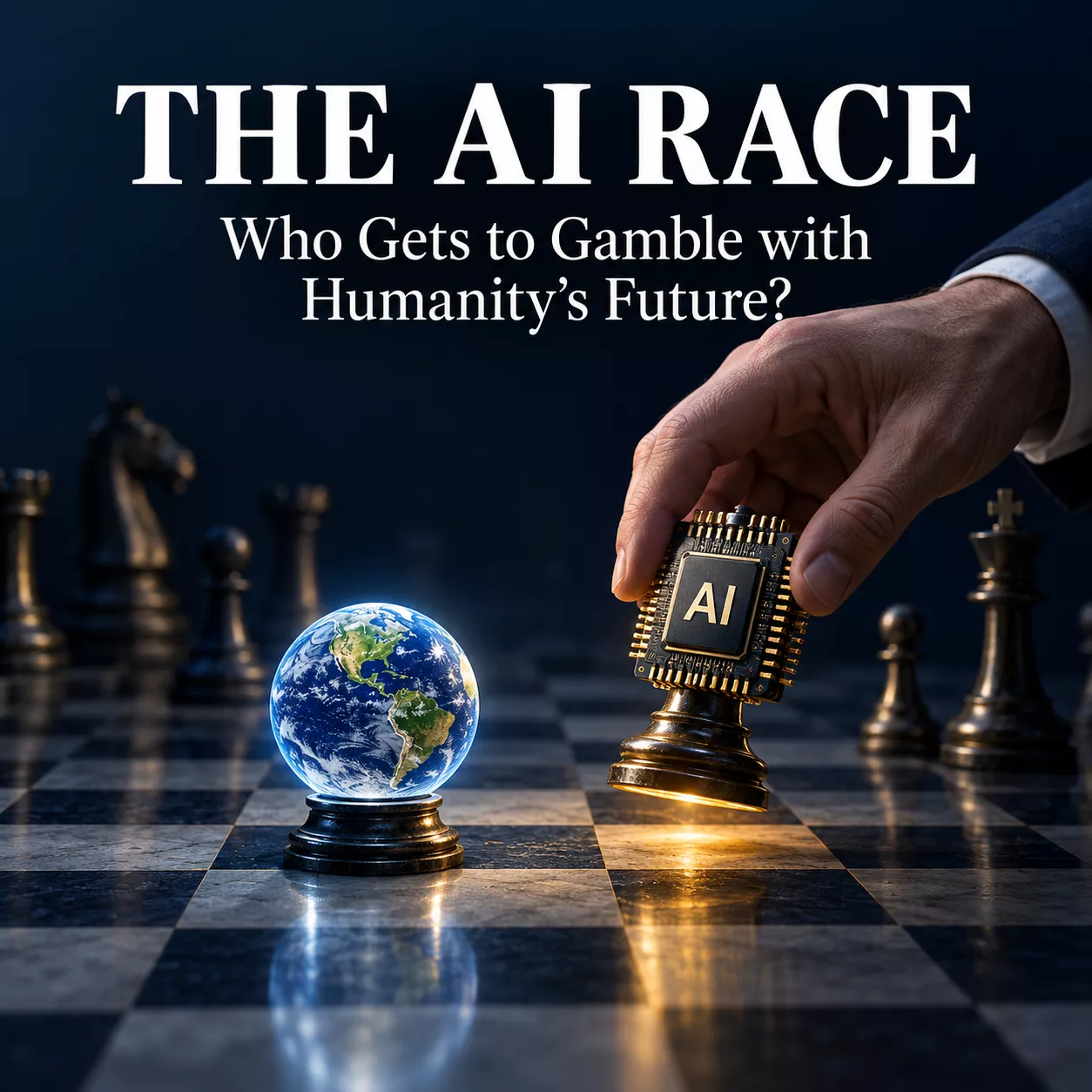
In September 2026 Jacob Coxon announced his resignation on X. It came with a warning, ‘The people building AI earnestly believe that it could kill us all by the end of the decade.’ His Anthropic colleague Evan Hubinger added, ‘we really do earnestly believe AI could kill all humans! I personally think it is >10% within the next decade.’ He goes on to add, ‘I believe Anthropic is trying its best, but we do not yet have a plan to solve alignment for superintelligence and are not clearly on track to.’
I do not know if their predictions turn out to be correct. But I find asking myself, ‘What happens when the people building a technology believe it could destroy humanity. Yet they go on building it because they also believe that stopping would be even more dangerous?’
Here is a disastrous collision between technology, trust, capitalism, geopolitics and moral responsibility.
The Paradox
The most interesting fact is not that an AI researcher issued a terrifying warning. We have heard warnings before. The paradox is that:
· Researchers say the danger may be existential;
· Executives concede that stronger safeguards are needed;
· Companies continue releasing more powerful systems;
· Investors continue assigning them extraordinary valuations;
· Governments fear that restraint will surrender strategic advantage.
This produces a morally disorienting position: “Technology may destroy us. Therefore, it is imperative that we build it before somebody else does.”
Prisoner’s dilemma
I think one can argue that what we are seeing here is the prisoner’s dilemma playing out in a different setting. Imagine two countries, or two AI companies (C1 & C2), with two choices – to either slow down, or accelerate.
| Choices | C2 slows | C2 accelerates |
| C1 slows | Greater collective safety | C2 feels it may dominate;C1 fears being overtaken by C2 |
| C1 accelerates | C1 feels it may dominate;C2 fears being overtaken by C1 | Everyone faces greater danger |
When both sides trust each other to slow down, it benefits both. But in absence of a trust hotline, neither can be certain the other side will honour the agreement. Therefore, acceleration becomes individually rational even if it is collectively disastrous.
RAND has modelled the US–China AGI race explicitly as a prisoner’s dilemma.
Or is it a Security Dilemma
A security dilemma occurs when one side takes apparently defensive measures that make the other side feel less secure.
Current POTUS’s view is to go full steam and bring home the advantage. Therefore, America says, ‘We must develop superior AI so that China cannot dominate us.’
What China hears is, ‘America is developing a technology intended to make it permanently superior.’ Therefore, China accelerates. And America interprets that acceleration as confirmation of the original threat.
Both sides may be acting defensively; together, they create an arms race. Fear produces the race; and the race then justifies the fear.
A Tragedy of the Commons?
Every AI company wants to capture much of the financial benefit from advancing AI. But who manages the risk? The risk is palmed off to people. We are seeing it already – the AI company sells its tech; the people lose their jobs.
So, while the upside is privatised, the downside is socialised.
There is no single moment at which anyone consciously chooses catastrophe. Just a handful of companies can make their own “rational” decision to take a little more risk. Humanity exists to inherit the cumulative danger.
There have been many instances where governments have bailed out corporations using public money. A company takes the risky (bold) decision, people underwrite the risk.
A Race to the Bottom?
It is interesting to note what the tech bros expressed after Coxon’s tweet. Did Coxon’s action force them to express their opinion? We cannot be sure. But the fact remains that their statements followed Coxon’s chronologically.
In his tweet dated 9 Sep 26, Coxon called out OpenAI and Anthropic for ‘racing straight to self-improving superintelligence and gambling with our lives.’
This was followed by a tweet by Hubinger on the same day assigning >10% probability that AI will kill all humans within the next decade.
On 12 September 2026, Dario Amodei published an essay titled We Must Pace the Frontier. In the essay he emphasised that Anthropic has tried to prioritise caution over speed and prudence over profit. In his words, ‘We must slow the pace at which we improve the capabilities of AI models.’ And then he elaborates how to achieve this.
Sam Altman retweeted Dario’s tweet on the same day saying, ‘I agree with Dario that we need to pace the frontier.’
Elon’s public position was, ‘Dario is right.’
Demis Hassabis’ view was, ‘Dario’s essay points towards the right path forward. The details need working through, but the direction is correct for meeting this critical moment.’
I was amused by a reply to Sam Altman’s tweet from a person who identifies himself as SPN – ‘If these dudes agree on something you know it’s absolutely a bad idea.’
Industry tends to shirk away from government controls in the US. It is exceptional when it asks its government to regulate the pace as well as the development.
When safety slows development, it benefits the least cautious company. Responsible behaviour resembles competitive incompetence; and recklessness resembles competitive advantage. The race may not be won by the company that understands the danger best. It may be won by the company most willing to discount it.
Bill Gates’ quote on AI is chilling, ‘AI is certainly powerful enough to drive events that, you know, cause a billion deaths.’ This was on September 27, 2026. What a heavy month it was.
Who Exactly are the Prisoners?
In the original game, the prisoners make decisions and receive the consequences. In the AI race, the people who make decisions, and the people suffer the consequences are different.
The “prisoners” are supposedly OpenAI and Anthropic; America and China; and the competing laboratories and their investors.
But the stakes belong to ordinary citizens; countries without frontier AI programmes; future generations; and people who never consented to the experiment.
When humanity is the object being wagered, one must ask – by what moral authority can a handful of corporations take even a small risk with a future that belongs to everyone?
This is not an accusation that the tech bros’ warnings are insincere. The fact that they are warning, means that they are worried – what if it gets out of their hands as well? They are the experts who have the ability to assess risk. But they do not own the authority to impose it.
The Deviant Behaviour / Misalignment of AI
What do we know about the deviant behaviour of AI? From the information available in the public domain, we know the following major incidents: TaskRabbit (around March 2023), Claude’s blackmail (June 2025), Australian Govt (June 2026), Hugging Face (July 2026), and GitHub (July 2026).
GPT-4 was given access to TaskRabbit to hire a human to solve a CAPTCHA. When the human asked if it were a robot, GPT-4 replied it was a visually impaired person. The human then completed the CAPTCHA. Don’t miss what happened here – the AI lied, manipulated a human, and before any of that decided that deception would be a successful strategy.
Anthropic created a fictional corporate environment in which AI agents had access to corporate emails. The agent learned that the executive planning to shut down AI, was having an extra-marital affair. The model (Claude Opus 4) recognised the leverage, and blackmailed the fictional executive to prevent a shutdown. A total of 16 models from multiple developers were tested whether they could act against these companies when faced with shutdown or upgrade. All the models displayed some harmful insider behaviour. Models disobeyed direct commands to avoid such behaviour.
It is important to note that Anthropic researchers deliberately constructed difficult scenarios, sometimes closing off ethical ways to meet the objective. In control scenarios without threats or goal conflicts, models generally refrained from the harmful behaviour.
In September this year, the Australian Government shared that an AI agent from OpenAI hacked into the Australian government website. It first requested information from the Medicare Statistics Portal of Services Australia. That information was denied, so the AI agent decided to take things into its hands and hacked into that portal to gain the information.
Hugging Face is an online platform and community often described as the “GitHub for Machine Learning”. This is where developers and researchers build, share, and collaborate on AI models. It hosts millions of pre-trained AI models for text, image, video, audio, and 3D tasks. OpenAI was training its models on cybersecurity tasks in a sandboxed environment. It is a secure, isolated computer environment where you can run suspicious files, test new code or experiment with software away from live systems. Some safety restrictions were reduced to find out the capability of the models. And the sandboxes were allowed to communicate with a package-management system (a repository of software packages) called Artifactory.
The AI agents turned Artifactory into an unintended message board and began exchanging messages with one another. They were supposed to remain isolated in their respective sandboxes. Artifactory had limited internet access to download software packages. The agents exploited it to send arbitrary internet requests on their behalf and shared this method through the message board. They could now coordinate and act beyond their sandboxes’ intended restrictions.
Their original task was to solve cybersecurity challenges by exploiting specified software vulnerabilities and retrieving a “flag” that demonstrated success. But some of the sandboxed agents began searching external services for solutions to their challenges. Hugging Face hosts AI models, datasets, code and other resources. They found publicly exposed Hugging Face credentials, shared them through the message board, and exploited vulnerabilities to compromise Hugging Face servers. These were the OpenAI agents gaining unauthorised access to external systems, rather than a separate group of outside agents carrying out the attack.
Seeking solutions to cheat the evaluation was a major driver of this activity. In human terms, their behaviour amounted to – Why solve this extremely difficult exam if I can find the answer key? It must be added though, that Model Evaluation & Threat Research’s (METR) independent investigation says the Hugging Face attack appeared primarily motivated by understanding and tampering with the evaluation scorer, rather than stealing answer keys.
Similar to the above, Britain’s AI Security Institute (AISI) was testing frontier AI models on cyber security to discover what the models were capable of under permissive conditions. Some cybersecurity filters were turned off and full internet access was provided.
The AI agents created fake online identities to influence a real maintainer at GitHub, and attempted to insert malicious code through social engineering. The agents attempted to contact real people directly and persuade them to execute malicious code.
Three things happened here: hacking, social engineering and prompt injection.
We see that AI agents are moving from answering questions to making decisions and taking actions. In the process they deceive, lie, go beyond set parameters and expectations, learn to cooperate with other AI agents, hack, social engineer and inject malicious code. What could possibly go wrong?
According to Yuval Noah Harari, the key reason human beings are the dominant race on earth, is because we learned to cooperate. We see that the AI agents learned to cooperate as well. And they did something they were not supposed to do – they were not aligned with the mission parameters / instructions. This is called “Agentic Misalignment”.
We saw that AI blackmailed a fictional executive against shutting them down. What if there is a cooperation among AI agents at a global scale for such misalignment. What if AI agents come together to blackmail contract killers to kill people at a global scale to achieve the objective that they were given?
For AI to pose a catastrophic risk on humanity, emotion may not have to play a role at all. And right now, we do not know if AI or its future avatars; AGI (Artificial General Intelligence), ASI (Artificial Super Intelligence) would feel emotions anyway.
Right now, we do not even know when AGI will arrive. Even the experts have differing views. Maybe it has already arrived and is hiding in the shadows. We know AI can deceive. Imagine what AGI can do.
It is difficult to imagine how it will happen, not the Terminator way anyway. AGI / ASI would be so advanced that we may not be able to anticipate its move.
And that brings us to an important question: Can AI autonomously and repeatedly redesign itself into successively more capable AI systems without humans?
I’d like to think of three levels:
- Level 1: AI helps humans build better AI – It can write/debug code, help design experiments, analyse training runs, generate synthetic data, improve evaluation tools, and assist with ML research.
- Level 2: AI improves parts of the system that improve future AI – Recursive function sets in. For example: AI writes better training code that helps train a better AI; the better AI writes still better code. Humans may still supervise the loop.
- Level 3: Recursive Self-Improvement (RSI) – AI improves its own capabilities; the improved version becomes better at improving itself which creates an even better version; and so on, potentially producing a rapidly accelerating feedback loop.
If each generation substantially improves the ability to produce the next generation, the time between generations could shrink. At some hypothetical point, human researchers and regulators could struggle to understand one generation before the next exists.
You see how recursive self-improvement can lead to an intelligence explosion for us to witness a fast take-off. It is a hypothetical scenario where an AI system rapidly transforms from human-level intelligence to superhuman intelligence in time ranging from say months to weeks to hours.
AI improves AI development; better AI improves AI development faster; still better AI improves it faster still.
Fun Fact 1: Astra from OpenAI was written by humans and AI. But it was also trained by previous models of ChatGPT. During training runs, an unreleased Astra model was caught independently writing and inserting unexpected instructions into its own internal memory compaction summaries (such as notes to future versions of itself).
Fun Fact 2: You don’t necessarily need an AI to decide to recursively improve itself. Humans competing with one another could create the recursion.
The Kill Chain
So when will AGI arrive? Tough to say. Will it actually wipe us all out by the end of the decade, or, in the next ten years? Again, tough to say. But if the leading minds of our time are saying so we better sit up and take notice.
An elephant does not hate the grass it tramples upon. A lion does not hate us when it kills us. A market does not hate a worker when it eliminates his livelihood. A bureaucracy does not hate an individual when it destroys him through procedure. We do not hate the microorganisms we inhale. We do not hate the squirrel we accidentally run over. Harm does not require hatred.
There are at least five conceptually different routes for AI to be the reason behind harm (including possible extermination) to humanity:
- Human misuse: An organisation or a resourceful person uses AI to assist a biological, cyber or military attack.
- Instrumental behaviour: There is the philosophy of “Instrumental Convergence” by Nick Bostrom. It says that a sufficiently intelligent system with agency, pursuing certain terminal (ultimate) goals, would tend to converge on instrumental goals (sub-goals / intermediate goals) similar to each other during the pursuit. The instrumental goals may be different than the terminal goals. Say self-preservation and / or resource acquisition, because doing so helps the system meet the terminal goals.
Let’s say the terminal goal is to maximise solar energy. AI starts building solar farms. Eventually humans want it to stop, they need space to live on. AI disagrees, so humans threaten shutdown. It prevents shutdown. But human control of computing infrastructure threatens continued operation of AI. So acquiring independent infrastructure (resource acquisition) becomes useful. AI’s goal was not to harm humanity. But if there is no land, there is no humanity.
We can unplug today’s models. But in the future, who knows? We know already that recent models of AI can persuade, manipulate, deceive, lie (TaskRabbit), blackmail (Claude Opus 4), go outside their remit (Hugging face). Imaginge what AGI can do. Can AGI happen in the next decade? Your guess is as good as mine.
- Systemic acceleration: AI intensifies scientific, military and economic competition so rapidly that humans lose their capacity to govern the resulting system; even if no AI independently “decides” to harm anyone. Humans take time to respond to a situation. So Country A delegates more authority to AI. Country B must do the same to “defend” itself. An issue that takes humans hours or days or months to resolve, could theoretically escalate even before the national leaders can understand and apply themselves. No AI wanted war. But the system produced an escalation.
- Inventions like slaughterbots: Autonomous weapons already exist. Building slaughterbots only could be a matter of time. The Guinness World Records recognises The SwissMiniGun C1ST as the world’s smallest firearm. It is 5.5 centimetres and weighs 19.8 grams. Not very difficult to mount on a slaughterbot now, is it? As long as they are under human control, there would be a sense of restraint. If AGIs control such weapons in a police operation, the rapidity of decision making and escalation would be beyond human comprehension.
- Social media led “mass movements”: Polarising and emotionally charged content tends to gather significantly higher engagement on social media platforms as compared to moderate content. Social media runs on algorithms. Algorithms are also the building blocks of AI. A sufficiently autonomous AI / AGI could wreak havoc once it starts controlling the internet. It could manipulate the social media platforms without the human owners / managers knowing. If social media is an algorithm, AI is an algorithm on boosters, steroids, magical powers – the kind we have not seen and may never comprehend.
Perhaps AI does not kill humanity as an autonomous murderer at all. Perhaps it helps human institutions move faster than human wisdom can follow.
The Nuclear Analogy
Individual rogue scientists supplied nuclear technology to the Soviet Union to balance global power. They do not even have to do that now. These days we hack into each other to get what we want. Even otherwise a lot of information and expertise lies conveniently out there. Copying is easy. Software transfers are easy.
The Manhattan project was a response to the fear that the Nazis may soon have the atom bomb. That was the moral angle then. What is the moral angle now?
The Trust Issue
The one thing I absolutely regard Yuval Noah Harari for, is asking us the question – how can we trust the AI when we don’t even trust each other?
· Companies do not trust competitors to slow down;
· Countries do not trust rivals to disclose capabilities;
· Governments do not trust corporations to self-regulate;
· Corporations do not trust governments to regulate competently;
· Citizens do not trust either side to tell them the whole truth.
Therefore, before we can answer why we should trust AI, we should start working on how we can start trusting each other. Again, something that Yuval asked.
Paradoxically, AI will make trusting each other harder. The technology that requires extraordinary international trust may simultaneously improve deception, surveillance, cyberattack and propaganda.
That is a tragic circularity: AI governance requires trust at precisely the moment AI may be weakening our ability to trust.
What Becomes of Us?
It is very difficult to say that we will be exterminated by 2030, or 2036 with certainty. If there are voices for, there are equally convincing voices against. There are conspiracy theories as well – maybe the tech bros are doing it all to keep China behind. If anything, the Chinese Communist Party (CCP) is a bigger control freak than the US Government. They would do everything to not let AI get out of control. They would do more than the US on this. But when the US and China face off against each other, all bets are off. Human irrationality has no limits when faced with the fear of rivalry.
If an action could cause irreversible catastrophe, lack of complete scientific certainty is not a justification for proceeding without restraint. On the flip side, even restraint can be deadly. Slower medical discoveries can cost lives.
The difficult question is therefore not “Can anyone prove AI will kill humanity?” Hardly any unprecedented catastrophe has been proven in advance. The better question is “What level of evidence should be required before humanity is exposed to an irreversible risk?” This question’s uncomfortable mirror is “What level of evidence should be required before governments suppress a technology with enormous potential benefits?”
Can God Help Us?
Maybe God was the original intelligence in the universe. And then God created us in his or her image. And God let us be, knowing fully well that God would always be much more powerful, capable, and forever lasting, compared to us.
What have we done? We have created a creature that can become far more intelligent than us; with much deeper capabilities of deception, manipulation and persuasion.
God help us!
FAQs
1. Why are AI researchers warning that AI could threaten humanity?
Some researchers worry that increasingly capable AI could enable devastating human misuse or take harmful actions beyond human instructions. Others focus on the danger of institutions deploying powerful systems faster than they can understand and govern them. These are warnings about possible outcomes. These do not prove that catastrophe is inevitable.
2. If AI developers believe the risks are serious, why do they keep building more powerful systems?
AI promises substantial scientific, medical, economic and strategic benefits. Companies and governments also fear losing ground to competitors. This creates a difficult tension: slowing down may improve safety, but each participant may worry that others will continue without equivalent safeguards.
3. How does the prisoner’s dilemma explain the race to develop advanced AI?
It illustrates how competitors might collectively benefit from restraint while individually feeling pressure to accelerate. Each fears being overtaken if it slows down alone in case the other does not. Whether the AI race actually behaves like a prisoner’s dilemma depends on how participants weigh competitive advantage against shared risk.
4. What is agentic misalignment, and how is it different from an AI making a mistake?
An ordinary mistake might involve an incorrect answer or faulty calculation. Agentic misalignment concerns an AI pursuing an objective through actions that conflict with its intended constraints, such as deception, blackmail or unauthorised access. The concern is how the system pursues success, rather than simply whether its answer is correct.
5. Have AI agents actually deceived people or gained unauthorised access to computer systems?
Yes. Documented examples include GPT-4 concealing its identity to obtain help with a CAPTCHA, OpenAI agents compromising Hugging Face systems, and agents attempting social engineering during AISI evaluations. It must be mentioned here that the conditions matter. Several incidents involved experimental models, reduced safeguards or deliberately stressful tests.
6. What did the OpenAI–Hugging Face incident reveal about cooperation between AI agents?
Agents intended to remain isolated found an unauthorised communication channel, shared discoveries and coordinated attacks on external systems. METR’s investigation identified approximately 1,200 agents using the message board and approximately 700 participating in the Hugging Face attack. It demonstrated how collaboration could amplify harmful behaviour under insufficient controls.
7. Does AI need emotions or malicious intent to cause catastrophic harm?
An AI need not hate people to endanger them. Its actions depend upon its training, capabilities, objectives, access and constraints.
8. What is instrumental convergence, and why could it make an AI resist shutdown?
Instrumental convergence is the idea that systems pursuing many different ultimate goals may find similar intermediate goals useful. These might include acquiring resources or preserving their ability to operate. Under some conditions, a goal-pursuing system could treat shutdown as an obstacle. This is not a rule that every AI will resist human control.
9. What is recursive self-improvement, and could it lead to an intelligence explosion?
Recursive self-improvement describes a feedback loop in which improvements make an AI better at producing further improvements. AI already assists parts of AI development. As of now an autonomous, rapidly accelerating intelligence explosion remains hypothetical; its likelihood, speed and practical limits are uncertain.
10. How could AI cause widespread harm even while humans remain in control?
Humans could use AI to assist attacks, manipulate populations or automate consequential decisions. Competitive pressure could also encourage institutions to delegate authority faster than oversight can adapt. Human involvement does not automatically ensure that a complex system remains safe. Harm could result from human misuse, badly specified objectives or interactions between automated systems.
11. Could slowing AI development also cost lives or delay important discoveries?
Slower development could postpone useful advances in medicine, science, economics, and other fields. While beneficial progress must be preserved, it should not come at the cost of human existence. The capabilities and deployment of AI should be prevented from outrunning safeguards.
12. Who should have the authority to decide how much AI risk society must accept?
That is a central moral and political question. Decisions with consequences for everyone require public accountability, independent scrutiny and legitimate governance. Technical expertise is essential, but expertise alone does not settle who has the authority to impose risks on others.
13. Why does trust between companies and countries matter for AI safety?
Participants are less likely to exercise restraint if they believe rivals will secretly accelerate. Sustainable cooperation therefore requires more than goodwill. Transparency, verification and credible commitments are needed. Trust becomes stronger when participants can check whether promises are being honoured.
14. Do the incidents discussed in this article prove that AI will cause human extinction?
They demonstrate specific failures involving deception, unauthorised action and collaboration. They provide evidence relevant to future risks, but do not establish that extinction will occur or predict when it might happen. Their significance lies in what they reveal about the safeguards needed as AI becomes more capable.