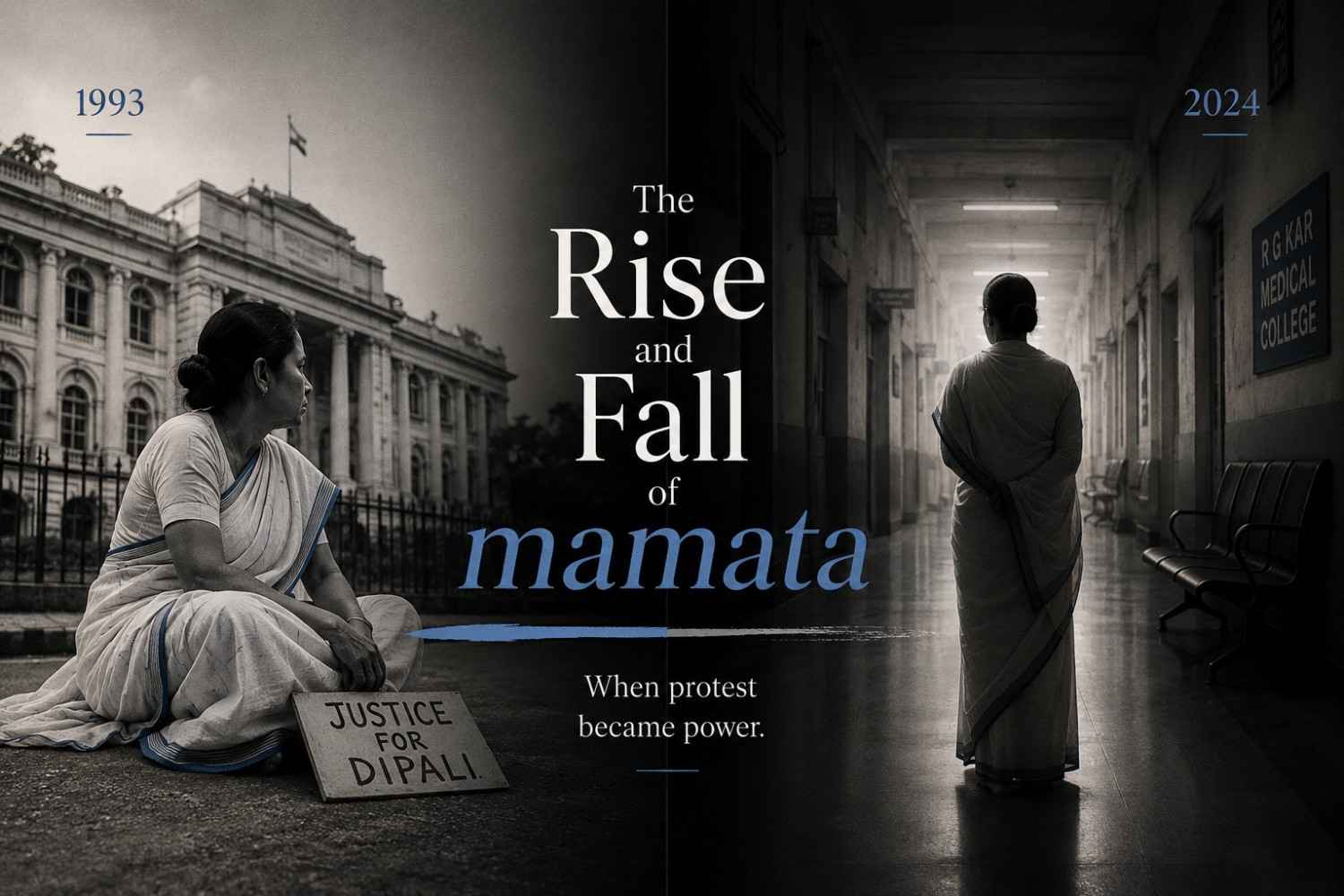
Between the Dipali Basak rape case in 1992, and the Abhaya rape-murder case in 2024 (R G Kar Medical College) lies the arc of “mamata”. I am careful here when I write “mamata” and not Mamata – the former being a profound state of emotion, the latter being just the name of the CM of a state.
The emotion of “mamata” encompasses the feelings of unconditional love, sacrifice, care, and a deep nurturing affection. It is the essence of motherhood – the maternal instinct. It evokes an immediate, emotional response; the idea that someone will stand up when it matters most.
But what happens when that instinct is tested by power?
Two incidents in West Bengal, separated by over three decades, offer a way to examine that question.
1993: The Dipali Basak Moment
The then 38-year-old Union Minister for HRD, Youth Affairs & Sports, and Women & Child Development in the PV Narasimha Rao government, Mamata Banerjee livid and horrified with how things turned out with Dipali, decided to take the matter right to the then CM Jyoti Basu.
Dipali, a deaf & mute girl from Phulia (Nadia), West Bengal, was allegedly raped by a CPM worker.
On the 6th of January 1993, Mamata met Dipali and her mother Felani, and took an appointment from Jyoti Basu. The next day when she went to meet with Jyoti Basu, he refused to meet her & Dipali. Mamata then staged a sit-in dharna. After about three hours of protest the police dragged her out, she was pulled by her hair, and her saree was torn.
Dipali, pregnant at that time was injured and rushed to Ramakrishna Seva Pratishthan, a charitable hospital run by the Ramakrishna Mission, whereas Mamata was taken to the Lalbazaar lock-up from where she was released later pressed by the gathering Youth Congress supporters.
On her way home in a police escort, she stopped at the Gandhi statute Mayo College Road. It is said that it is here that she made a vow to enter Writers Building next only as a CM and after dislodging CPM from power.
The protest at Writers’ Building during the Dipali Basak case became one of the defining moments of this image. She was seen not as a distant politician, but as someone willing to challenge power structures in real time.
The Making of a Political Identity
Moments like 1993 do more than create headlines; they build reputations. Over time, Mamata Banerjee’s political persona came to be associated with accessibility, emotional immediacy, and a willingness to confront authority.
This identity played a significant role in her eventual rise to power. When she became Chief Minister of West Bengal on 20th May 2011, it was seen not just as a political victory, but as the arrival of a leader shaped by grassroots संघर्ष (struggle).
She created history by exiting CPM ending its 34-year rule in the state – the longest tenure for an elected communist government anywhere in the world.
Mamata Banerjee built her political identity not through institutional power, but through visible, emotionally charged public engagement. Long before she became Chief Minister of West Bengal, she was known for street-level politics – leading protests herself, sitting on dharnas, confronting authorities directly, and physically appearing beside victims, workers, and protestors.
Her persona also became associated with emotional immediacy because she communicated more through instinct and visible emotion than bureaucratic language. Her speeches often sounded personal rather than administrative. Combined with her simple public presentation, cotton sarees, slippers, modest lifestyle optics, and the widely used identity of “Didi,” she came to represent familiarity and accessibility rather than hierarchy. Supporters felt she reacted first as a human being and then as a politician. This perception deepened further during movements like Singur and Nandigram, where she positioned herself as the emotional face of public grievance ready to take on authority.
The emotional construct of “mamata” was all visible & established amongst people’s conscience. She was the hero people feted. She was the hero they wanted to give their power to, through vote.
But power changes the nature of leadership. And with it, the expectations.
2024: The RG Kar Medical College Case
In August 2024, a young postgraduate trainee doctor, whom we know only as Abhaya, was found raped and murdered inside RG Kar Medical College and Hospital. The details were deeply unsettling – The crime occurred within a hospital campus, and the victim was part of the healthcare system itself. The setting challenged assumptions about safety in institutional spaces. The reaction was swift.
Doctors across India protested. Medical services were disrupted. Public discourse turned sharply toward questions of safety, accountability, and administrative response.
The investigation was eventually transferred to the Central Bureau of Investigation. But the core issue extended beyond the crime. It was about how the system responded in the immediate aftermath. Concerns were raised about initial handling of the case, communication from authorities & the perceived tone of the state’s response.
At the centre of this response was Mamata Banerjee, not as a protester, but as the Chief Minister.
From Instinct to Institution
The contrast between 1993 and 2024 is not simply political. It is structural. In 1993 Mamata Banerjee was structurally an outsider to state power. Even though she was a Union Minister, in West Bengal she functioned as an opposition leader confronting the ruling establishment. Her political role was to question the system, amplify the victim’s voice, and morally challenge authority. Her strength came from moral clarity and immediacy.
By 2024, the structure had completely reversed. She was no longer confronting the state – she was the state. Her role was to manage, respond, and ensure accountability. The police, the administration, the health system, and the political accountability mechanisms all operated under her government.
That changes the nature of leadership fundamentally. A protest leader derives legitimacy from moral clarity and emotional immediacy. A governing leader is judged through institutional response, administrative competence, and public trust in systems.
That is why the contrast in later years became so symbolically significant. The same leader who rose by appearing emotionally available during moments of injustice, eventually became the institution expected to manage crisis, process, and accountability. Therefore, much of the public conversation around cases like the RG Kar incident is shaped not only by governance questions, but by the memory of the earlier Mamata – the leader whose politics once seemed driven by instinctive empathy and immediacy.
The Shift that People Noticed
The memory of 1993 is simple and enduring – a leader who refused to leave a victim unheard.
The perception in 2024, however, is more complicated – a system that moved slower, more measured, less empathetic, less sympathetic, and, to a vast majority, responsible for what had happened.
People understand that governance demands caution, verification, and process. But people’s perception often judges leadership not by the internal complexity of governance, but by how the response feels emotionally and morally. When response feels delayed or impersonal, it creates a gap. And that gap is where symbols begin to weaken.
People’s anger wasn’t just about the crime. It was about the response. Allegations of delayed or mishandled initial investigation surfaced. Public trust seemed fragile. The state appeared defensive, not empathetic.
And at the centre of it all was the same leader who once sat in protest – now the Chief Minister.
Did Mamata Lose Because She Lost Her “mamata”?
This is not a question of political success or failure. It is a question of alignment. The rise of Mamata Banerjee was closely tied to the idea of “mamata” – the instinct to act, to stand beside, and to confront injustice without hesitation.
The challenge of leadership is to retain that instinct even when power demands restraint. If the public begins to feel that the instinct has faded, that response has become more administrative than empathetic, then the symbol starts to erode.
It is a gradual shift. And when that happens, political outcomes often follow perception. Leaders are not expected to react the same way in opposition and in power. But they are expected to feel the same way.
That emotional continuity, visible through action, is what sustains public trust over time.
“Mamata” means motherhood. It implies instinctive protection, a refusal to tolerate harm, an emotional immediacy.
In 1993, that instinct was visible – raw & uncompromising. In 2024, it felt distant. Filtered through systems, politics, and control. It is the distance between who you were when you fought power and who you became when you held it.
The Distance Between Two Moments
Two incidents. One state. Thirty years apart. The Dipali Basak case revealed a leader willing to challenge power in defence of a victim. The Abhaya / RG Kar case has tested whether that instinct survives within power.
The answer is not binary as to whether the leader retained her moral instinct, or completely lost it. But it leaves behind an important reflection that leadership perhaps, is not just about rising to power. It is about carrying forward the very instinct that made that rise possible.
Because in the end, “mamata” is not defined by a name or a position. It is defined by whether, in moments of crisis, the response still feels human.
In 1993, Mamata Banerjee challenged power.
In 2011, people vested in her, their power.
In 2024, she was the power being challenged.
In 2026, people divested her of that power.
And she may have lost power because she first lost the emotional trust that created it. In the end, “mamata” is not just a name, it is a responsibility.
About Dipali and Abhaya
Dipali gave birth to a girl child. She died in March 2009 due to snakebite. As per Felani Basak (Dipali Basak’s mother), Mamata never visited them again. Dipali’s elder brother Nikhil said that Mamata never enquired about Dipali after the Writers Building incident. Felani died in March 2025 at the age of 91.
Ratna Debnath, Abhaya’s mother won from the Panihati Assembly constituency in the 2026 West Bengal Assembly elections.
I am an ordinary people. My heart goes out to Dipali & Abhaya and all others named and unnamed who suffered. God bless them all.
Sources & References:
Dipali Basak Case / 1993 Protest
• Throwback 1993: Mamata Banerjee Made A Vow, Then Kept It For 18 Years
• Head held high but back-door arrival
• Forgotten mother’s justice wish
• Felani, whom Mamata took to Writers’ seeking justice, dies aged 91